
The science · Dosed in the open

Every
ingredient.
Every
dose.
Every
study.

Protocol is built on published research. Here is what each ingredient is, how much you get, what the studies found and where the evidence stops.

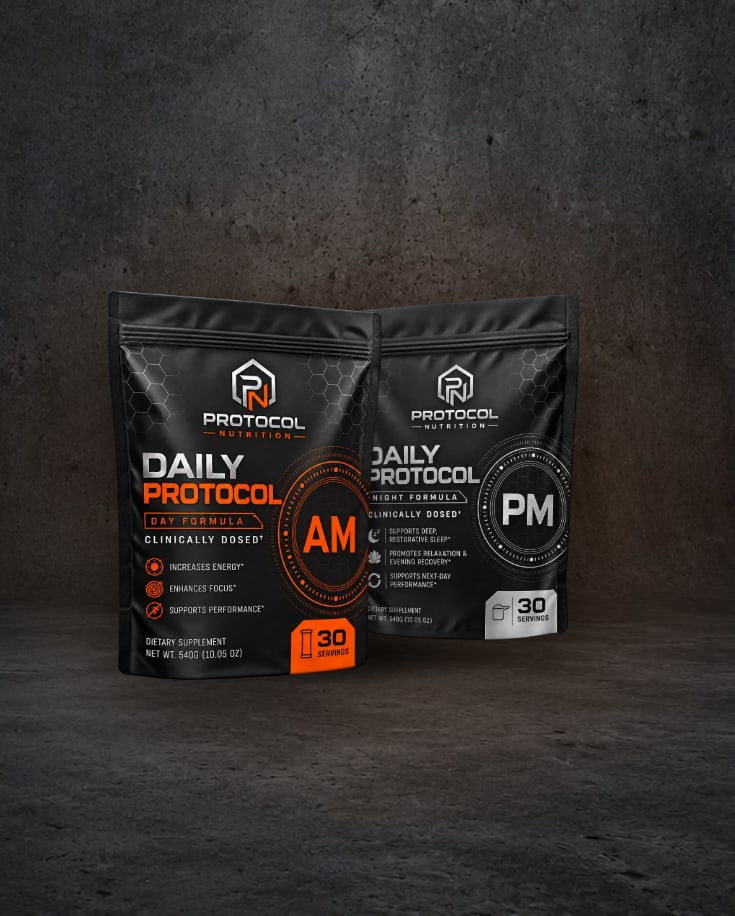
Daily Protocol AM and PM pouches

Morning · Day formula

Protocol AM

Taken in the morning. Creatine leads, because it is the foundation of the system.

Daily Protocol AM pouch

Creatine monohydrate

Clinically dosed

5 g

in the morning, plus 3 g at night

The foundation of the system.

Creatine helps your cells recycle energy, in muscle and in the brain. It is one of the most studied supplements in the world, and the International Society of Sports Nutrition concludes it is safe and well tolerated. A 2024 analysis of 16 randomised trials found it may also support memory, attention and processing speed. Protocol gives you 5 g in the morning and 3 g at night.
Sodium and potassium citrate

About 900 mg

sodium, plus about 300 mg potassium

Hydration built for the heat.

Sodium is the main electrolyte you lose in sweat. Protocol AM replaces it as sodium citrate, with potassium alongside. In research on athletes sweating hard at 32°C, sodium citrate taken during recovery restored more plasma volume than placebo.

Taurine

Clinically dosed

2 g

Tested in more than 1,000 people.

Taurine is an amino acid your body concentrates in the heart, muscle and eyes. It has been studied in 25 randomised trials at 0.5 to 6 g a day, with no more side effects than placebo. Protocol AM sits inside that range.

Aronia berry extract

65 mg

Anthocyanins from aronia berry.

Aronia berries are rich in anthocyanins, the dark pigments also found in blueberries. In a six-month double-blind trial of adults aged 40 to 60, aronia extract improved psychomotor speed, the link between thinking and movement.

Night · Night formula

Protocol PM

Taken in the evening. L-theanine leads, because its dose matches the trial exactly.

Daily Protocol PM pouch

L-theanine

Clinically dosed

200 mg

The trial dose, to the milligram.

L-theanine is an amino acid found naturally in tea. In a four-week double-blind trial, 200 mg a day improved sleep quality scores, verbal fluency and executive function in healthy adults. A 2025 Australian-led analysis of 897 people points the same way on sleep.

Straight talk

The 200 mg trial had 30 participants and involved the ingredient supplier. Sleep results were self-reported. Few trials test L-theanine on its own.

Sources: Hidese 2019 · Bulman 2025

Glycine

Clinically dosed

3.5 g

For the morning after a short night.

In a controlled study, 3 g of glycine before bed left sleep-restricted people less sleepy and less fatigued the next day, with faster reaction times. Protocol PM gives you 3.5 g.

Straight talk

The main human sleep study had 10 participants. The research on how glycine works was done in rats.

Sources: Bannai 2012 · Kawai 2015

Saffron extract

28 mg

Saffron, an hour before bed.

In an Australian double-blind trial of 120 adults with poor sleep, saffron extract taken an hour before bed improved sleep quality ratings within 28 days. A 2025 trial using EEG sleep tracking found people fell asleep faster.

Straight talk

Two of the three trials used the branded extracts affron and Safr’Inside. Protocol uses a different extract, standardised to 0.3% safranal.

Sources: Pachikian 2021 · Lopresti 2021 · Lang 2025

Magnesium

About 350 mg

at night, plus about 155 mg in the morning

Magnesium, morning and night.

Researchers describe magnesium as a natural NMDA antagonist and GABA agonist, two pathways involved in winding down. In a 2025 double-blind trial of 155 adults with poor sleep, magnesium bisglycinate modestly improved insomnia scores in four weeks. Protocol uses bisglycinate in the morning and citrate at night.

Straight talk

The bisglycinate sleep trial used 250 mg, and Protocol AM provides about 155 mg. An older sleep trial used 500 mg of magnesium oxide in older adults with insomnia. Our morning and night split has not been tested in a trial.

Sources: Schuster 2025 · Abbasi 2012

  • Protocol PM also carries 3 g of creatine, which brings the day’s total to 8 g.

Honest by design

Our dose vs the study dose

We chose every ingredient in Protocol because published research supports it. That research has limits, and we would rather you hear them from us.

Some studies used higher doses than a serve of Protocol. The table below shows where.

How each dose in Protocol compares with the dose used in the published research
Ingredient In Protocol In the study How we compare Study
Creatine, daily 8 g a day (5 g AM, 3 g PM) Around 3 g a day noted for lifelong intake; up to 30 g a day reviewed as safe Above baseline

Well inside the reviewed range

Kreider 2017
Creatine, for sleep loss 8 g a day (5 g AM, 3 g PM) One dose of 0.35 g per kg, about 25 g for a 70 kg adult Above baseline

Well inside the reviewed range

Gordji-Nejad 2024
Taurine 2 g (AM) 0.5 to 6 g a day Within range Tzang 2024a
Glycine, night 3.5 g (PM) 3 g Slightly above Bannai 2012
L-theanine 200 mg (PM) 200 mg Matched Hidese 2019
Saffron extract 28 mg (PM) 14 and 28 mg Matched on dose Lopresti 2021
Magnesium About 355 mg elemental 250 mg elemental Above baseline

Well inside the reviewed range

Schuster 2025
Aronia berry extract 65 mg (AM) 65 mg a day and above Matched on dose Ahles 2020, Ahles 2024
Potassium About 300 mg, or 8 mmol (AM) 30 to 140 mmol a day; 60 mEq a day in a second trial Slightly below Filippini 2020, Jehle 2013

Questions people ask

Straight answers.

Does creatine dehydrate you in the heat?

No. A systematic review of controlled trials found no evidence that creatine impairs the body’s ability to shed heat or stay hydrated at recommended doses. Lopez 2009

Is it safe to take creatine every day?

Creatine is one of the most studied supplements in the world, and the International Society of Sports Nutrition concludes it is safe and well tolerated, with up to 30 g a day reviewed as safe. Protocol gives you 8 g across the day. Kreider 2017

Why put creatine and electrolytes together?

Creatine helps your cells recycle energy, and sodium is the main electrolyte you lose in sweat. Taking them together in your morning serve covers both before a long, hot day. Hummer 2019

Has Protocol itself been tested in a clinical trial?

No. Each ingredient is chosen and dosed against published research on that ingredient, and the table above shows where our dose matches, exceeds or falls short of the studies. Our morning and night split has not been tested in a trial.

Founding access

Your protocol starts here.

Be one of the first 100 subscribers and save up to 50%, or take 30% off a one-off order. Either way, the glass drink bottle’s on us.

References

Every study on this page.

25 published papers and one published correction, grouped by ingredient.